Blog

  • Oklahoma Tribes Lose Casino Compact Lawsuit Despite State Supreme Court Ruling

    Oklahoma Tribes Lose Casino Compact Lawsuit Despite State Supreme Court Ruling

    Four powerful Oklahoma tribes have lost a five-year legal battle to overturn gaming compacts negotiated between the state and two rival tribes, despite an earlier state Supreme Court ruling declaring the agreements invalid.

    Oklahoma Gov. Kevin Stitt, above, was at loggerheads with the state’s powerful casino-operating tribes when he negotiated the disputed agreements in 2020. (Image: Brandon Bell/Getty)

    US District Judge Timothy J. Kelly dismissed the lawsuit brought by the Cherokee, Chickasaw, Choctaw, and Citizen Potawatomi nations, finding they had failed to demonstrate that the disputed compacts caused them any actual or imminent harm.

    Controversial Compacts

    The dispute dates back to 2020, when Oklahoma’s Republican governor, Kevin Stitt, negotiated new gaming compacts with the Comanche Nation and Otoe-Missouria Tribe.

    At the time, he was locked in a dispute with the state’s other tribal casino operators over how much of their gaming revenue they should share with the state.

    The governor wanted to squeeze more payments out of Oklahoma’s numerous tribal casinos. He claimed that the model compact they had signed in 2004 expired on January 1, 2020 and would have to be renegotiated.

    The tribes argued that the language of those agreements indicated the compacts were designed to automatically roll over for another 15 years on that date.

    Breaking the Law

    Stitt claimed the tribes were breaking the law by offering Class III gaming after 2020. In October 2021, a federal judge agreed with the tribes’ interpretation, allowing gaming to continue.

    The agreements between the state and the Comanche and Otoe-Missouria offered terms that were significantly different from the existing model compact, including a flat 4.5% revenue-sharing rate for most gaming at existing casinos.

    Oddly, this was lower than the rates of up to 10% under the model compact agreement.

    But the new compact also contained provisions for sports betting, additional casino games, and up to six new gaming facilities, subject to legal and regulatory approvals.

    The US Department of the Interior allowed the agreements to take effect in June 2020 after failing to act within the statutory 45-day review period, a process known as β€œno-action approval.”

    Two months later, however, the Oklahoma Supreme Court ruled that Stitt had exceeded his authority by negotiating agreements authorizing gambling activities, such as sports betting, that were still prohibited under state law.

    The court declared the compacts invalid, finding the state could not legally be bound by them without legislative authorization.

    The four plaintiff tribes subsequently challenged the federal approvals, arguing that the agreements gave their competitors unfair advantages.

    No Evidence of Harm

    Judge Kelly rejected those arguments, finding that the plaintiffs had failed to establish legal standing to pursue their claims.

    The Comanche and Otoe-Missouria tribes already operated casinos before the disputed agreements took effect, meaning their continued presence in the market did not constitute increased competition, he reasoned.

    Meanwhile, the additional games contemplated by the agreements, including sports betting, remained unauthorized under Oklahoma law and so were not being offered.

    Plans for six additional casinos were similarly speculative because the necessary federal land-approval processes had not begun.

    The plaintiffs also argued that reduced revenue-sharing payments would allow their rivals to offer larger jackpots and better amenities, but the judge found no evidence supporting that prediction.

    Kelly noted that tribal gaming revenues also fund government operations and services rather than necessarily being reinvested in casinos.

    His dismissal does not resolve the question of the compacts’ federal legality, nor change the Oklahoma Supreme Court’s ruling they were invalid under state law.

    The post Oklahoma Tribes Lose Casino Compact Lawsuit Despite State Supreme Court Ruling appeared first on Casino.org.

  • Amazon’s New Gaming Ads Rules Classify Prediction Markets As Gambling

    As prediction markets continue to grow rapidly, there’s more and more discussion on whether they should be considered a form of gambling or not. Many US states argue they are, in fact, gambling, which has led to many legal clashes between them and prediction market operators such as Kalshi and Polymarket.Β 

    However, some private companies, which also consider prediction markets as a form of gambling, don’t have this issue. Amazon is the most recent example of that, as it recently updated its β€œGambling and Games” advertising policy to include prediction markets.

    What Does the Updated Policy Say?Β 

    The updated policy, which was published on November 15, covers 22 jurisdictions, including the US, UK, France, Germany, the Netherlands, and more. It introduces revised requirements governing the licensing, targeting, and placement of gambling-related advertisements. Requirements vary by jurisdiction, covering permitted products, minimum age restrictions for targeting, licensing obligations, and approved advertising placements.

    Advertisers seeking to promote gambling products must undergo verification by Amazon and provide evidence that they hold the necessary licences or are otherwise legally authorised to operate in their intended markets. They must also ensure that all relevant licences remain valid throughout the advertising campaign and promptly inform Amazon if any authorisation is suspended or revoked.

    Amazon further states that, across all markets, gambling advertisements must not be directed at individuals below the legal gambling age. Ads must also be assigned the appropriate content categories to minimise the likelihood of being displayed alongside material aimed at children or other vulnerable audiences.

    It’s not the first time major corporations such as Amazon have taken a firm stance on prediction markets. Earlier this month, Apple banned its employees from using prediction market platforms like Kalshi and Polymarket. However, the company’s main concern was the potential leaking of confidential information, rather than coming from a point of regulation or user protection.

    Rules In the US Are a Bit Different

    In the US, advertisements for online casinos and sports betting must be targeted at users aged 21 and over. However, prediction market promotions may be directed at audiences aged 18 and above. Furthermore, Amazon clarified that prediction market advertisements are exempt from the responsible gambling messaging and additional disclosure requirements that typically apply to gambling-related promotions.

    Amazon maintains strict placement restrictions across its platforms. For example, on Fire TV, gambling advertisements may only run between 5 pm and 6 am, with exposure capped at three impressions per user within 24 hours. Comparable restrictions apply to Prime Video and Streaming TV. There, gambling ads may only appear alongside content rated PG-13 or TV-14 and above.Β 

    While Amazon updated its policy, the rules for prediction markets ads in the US still seem to be more lenient than those regarding traditional gambling. However, if we look at a recent poll, it seems that the average US citizen doesn’t see a difference between the two products, as over 80% of the surveyed said that prediction markets should be regulated like regular gambling.Β 

    In other news about Amazon, earlier this year, the company launched the paid robotaxi service Zoox in Las Vegas after it previously spent months testing the system with free rides.

  • Nic Cage to Play Vegas Casino Owner in Series from β€˜The Office’ Alum

    Nic Cage to Play Vegas Casino Owner in Series from β€˜The Office’ Alum

    Nicolas Cage feels at home in Las Vegas on the screen as he does in real life, and the actor is seeking to extend his artistic ties with his adopted hometown. Now, according to Deadline, he’s attached to play a Las Vegas casino owner in American Epic, a new drama series from A24 (You Can See Everything) being written by B.J. Novak, the actor, writer, and producer best known for his work on NBC’s Emmy-winning The Office.

    Nicolas Cage attends the premiere of Amazon MGM Studios’ Madden in L.A. on Nov. 4, 2026. (Image: Axelle/Bauer-Griffin/FilmMagic via Getty)
    A plane flown by Cage’s Con Air character implausibly destroys a landmark sign before crash-landing at the Sands, which was more than a mile away from the Hard Rock Hotel. (Image: Touchstone Pictures)

    Cage is set to play Wyatt Pascal, a Las Vegas casino mogul whose quest to secure a lasting legacy places him in direct conflict with Midwestern pastor Bill Massey, a role reportedly set for Chris Pine.

    According to the project’s logline, the two men attempt to pull off an ambitious undertaking in Las Vegas, a city A24 describes as β€œthe most temporary place on earth.”

    The project remains in the development stage and is currently being pitched to buyers. Several major streaming platforms, including HBO and Amazon, are reportedly among those showing interest, although no network or streaming service has announced a pickup.

    Living Las Vegas

    Few actors have stronger cinematic ties to Las Vegas than Cage. He won the Academy Award for Best Actor for his performance in 1995’s Leaving Las Vegas and starred opposite Sarah Jessica Parker and James Caan in 1992’s Honeymoon in Vegas. In 1997’s Con Air, Cage’s character crash-landed a hijacked prison transport plane through a heavily fictionalized version of the Las Vegas Strip in one of the city’s most memorable action-movie scenes.

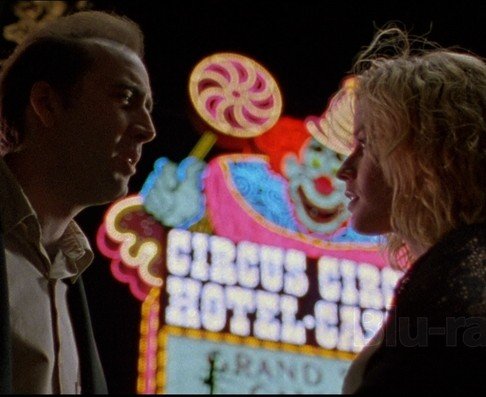
    Director Mike Figgis filmed Cage and co-star Elisabeth Shue for this Leaving Las Vegas scene without a permit or permission. (Image: United Artists)

    His more recent Vegas connections include The Trust (2016), in which he played a Las Vegas police lieutenant, and Sympathy for the Devil (2023), a thriller that begins in Vegas and unfolds across the surrounding desert landscape.

    If the series moves forward, it would mark the first live-action collaboration between Cage and Pine. Both actors previously appeared in the voice cast of 2018’s Spider-Man: Into the Spider-Verse, but their characters did not interact on screen.

    Cage is currently starring as Hall of Fame football coach and broadcaster John Madden in Madden, a biopic chronicling Madden’s Raiders years, broadcasting career, and role in creating one of the most successful sports video game franchises of all time.

    Following a limited theatrical release on Nov. 11, it begins streaming on Prime Video on Wednesday, Nov. 18.

    The post Nic Cage to Play Vegas Casino Owner in Series from β€˜The Office’ Alum appeared first on Casino.org.

  • Washington DC to Vote Whether It Wants Online Casinos on November 18

    In spring of this year, Washington DC, introduced Bill B26-0656, which aims to expand the district’s regulatory framework for online gambling. This week, the district’s residents are finally deciding if they want online casinos in Washington, with a vote on Wednesday.

    Washingtonians to Decide on Online Gambling

    If enacted, the bill would allow the state to introduce online casinos alongside its regulated sports betting market, which was legalized in 2018. While lawmakers are pushing to legalize online casino gaming, they also want to crack down on unregulated sweepstakes casinos. Under the proposed legislation, only licensed operators would be allowed to offer sweepstakes casino games.

    To assess the potential impact of legalizing online casinos, DC lawmakers should consider the performance of the city’s existing regulated mobile sports betting market. DC currently has six licensed mobile sportsbook operators, including FanDuel, BetMGM, and DraftKings. Some or potentially all of these operators could seek to expand their presence by applying for online casino licenses if the legislation is approved.

    Maine could be a good example to follow, but also a warning to DC Like the district, Maine legalized online gambling, but also said no to sweepstakes. Sweepstakes casinos, which operate using a dual-currency system, have posed challenges for states looking to establish their own real-money online casino frameworks.

    Although Maine legalized online casinos earlier this year, the launch of its first platforms has faced delays. The state has been working to clarify several regulatory details, including age restrictions and software requirements. Among the changes, Maine revised its rules to allow live casino operators to host games from locations outside the state.

    What Does the Bill Entail?

    Under the proposed legislation, DC online casino operators would pay a 25% tax on adjusted gross internet gaming revenue. Companies that want to operate in the district will have to pay a $2 million license fee, with a $500,000 renewal fee. All online casinos will be regulated by the Office of Lottery and Gaming.

    Interestingly, Bill B26-0656 doesn’t specify a cap for the number of operators that could offer their products in DC. However, unregulated sweepstakes casinos would still be banned outright if the legislation passes.Β 

    The bill also calls for the creation of an iGaming Community Reinvestment Fund, which would receive a 2% contribution from operators. The funds would be allocated to support problem gambling treatment programs across the region.Β 

    When introducing the bill, Councilmember Wendell Felder highlighted the β€œtough decisions” facing DC. He emphasized the need to find innovative revenue-generating opportunities without imposing additional financial burdens on residents.

  • Einhorn’s DME Capital Adds MGM Stake in Q3

    Einhorn’s DME Capital Adds MGM Stake in Q3

    David Einhorn’s DME Capital Management initiated a stake in MGM Resorts International (NYSE: MGM) in the third quarter, according to the hedge fund’s latest 13F filing.

    MGM’s Bellagio on the Las Vegas Strip. David Einhorn’s DME Capital Management bought shares of the casino stock in Q3. (Image: Getty)

    DME bought 1.1 million shares of the casino stock during the July through September period, making it one of three new long positions in the money manager’s portfolio. The other two are Century Aluminum (NASDAQ: CENX) and real estate investment trust (REIT) SL Green (NYSE: SLG).

    If SL Green rings a bell for gaming investors, that’s because the landlord was Caesars Entertainment’s (NASDAQ: CZR) partner on a Manhattan casino proposal that was ultimately vanquished.

    None of the stocks DME sold or added to during the third quarter were gaming equities.

    DME May Have Bought the MGM Dip

    The Securities and Exchange Commission (SEC) doesn’t require 13F filers to disclose why they’re transacting in stocks, nor does the regulator require those professional investors to tell the general public the exact dates on which they bought or sold securities.

    In the case of DME Capital getting involved with MGM, it appears as though the hedge fund bought the dip after the casino stock tumbled following news that Barry Diller’s People Inc. (NASDAQ: PPLI) withdrew its $48.30 per share takeover offer.

    DME’s 13F indicates its MGM stake was $34.1 million at the time of initiation. Based on that figure and the money manager buying nearly 1.1 million shares of the Bellagio operator, it’s possible, though not confirmed, that Einhorn’s firm bought shares of the casino giant the day after the People acquisition bid was withdrawn.

    Based on MGM’s closing price of $33.23 today, DME is likely flat on the trade or sitting on a small loss.

    Einhorn Is No Stranger to Casino Stocks

    MGM isn’t Einhorn’s first rodeo with casino equities. The hedge fund manager, who’s an accomplished poker player in his own right, has been around the block with gaming stocks. In fact, MGM joins Penn Entertainment (NASDAQ: PENN) as the casino names in the DME portfolio as of the end of the September quarter.

    Penn is a long-standing position for DME, though the money manager trimmed some of that exposure in the fourth quarter of 2025.

    Entering this year, the asset manager owned approximately 6.04 million shares of the regional casino stock. However, the latest 13F indicates that figure is now around 5.9 million, signaling that some modest pruning to that position has occurred.

    In other 13F/casino stock/hedge fund news, George Soros’s Soros Fund Management added to its MGM position in the third quarter while eliminating its position in Caesars, according to that firm’s latest regulatory filing.

    The post Einhorn’s DME Capital Adds MGM Stake in Q3 appeared first on Casino.org.

  • BGaming’s Luxury Feast Allows Players to Partake in Cozy Thanksgiving Celebrations

    BGaming has launched Luxury Feast, a new Thanksgiving-themed game that blends coziness with luxury, setting the tone for the upcoming holiday. With less than two weeks remaining until November 26, Luxury Feast is the perfect game to enjoy and perhaps even win prizes of up to 5,000x.

    Luxury Feast Metrics

    • Rows: 3
    • Reels: 5
    • Paylines: 60
    • RTP: 97%
    • Volatility: Medium
    • Min/max bet: 0.60/30
    • Max win: 5,000x

    BGaming Serves Up a New Hit

    Luxury Feast is a new addition to BGaming’s #Classic portfolio that allows the provider to tap into the fairly niche Thanksgiving theme. The new game pairs cozy autumn vibes with rich and luxurious aesthetics, resulting in an extremely pleasing final product.

    As a game that celebrates the traditions of Thanksgiving, Luxury Feast features various symbols associated with the holiday, such as cornucopias, pies, and, of course, turkeys. The turkeys serve as high-paying Scatter symbols, while a sauciΓ¨re with a buttery sauce serves as the game’s Wild symbols, substituting for all regular symbols.

    Golden Bell symbols, on the other hand, can call everybody to dinner, triggering the Hold & Win feature.

    With 60 paylines and an RTP of 97%, Luxury Feast is a true expression of the spirit of generosity associated with Thanksgiving. Players can also adjust their risk appetite and increase the paylines to up to 100, or lower them to 20, adding a major layer of personalization.

    Hold & Win Can Award Plenty of Prizes

    As mentioned, six or more Bell symbols initiate the Hold & Win feature, which switches to a 4Γ—5 grid where only Bells and certain special symbols can land. All bells that triggered the feature are kept on the grid and remain there for its entire duration.

    When the feature starts, certain positions are marked with multipliers and players are awarded three free spins. Every time they land a sticky symbol, the spin count is reset to 3. A counter located to the right of the grid keeps track of how many Bells have landed, turning bells into Progressive Multiplier symbols when certain milestones are hit.

    The Progressive Mystery symbols keep things interesting. Able to land only during the bonus, these symbols can turn into bells, a Multiplier symbol, or a Collect symbol. At the end of the round, Collect symbols gain a prize value equal to the values of all other symbols.

    Jackpot symbols can also land, awarding prizes of up to 500x.

    BGaming Designed the Game to Be Relevant Beyond the Holiday Season

    BGaming said that Thanksgiving is a theme that is not that popular among slot companies, which is why officials thought that launching one as the holiday approaches would be a good opportunity. Ruslan Shakhlovich, game designer at BGaming, elaborated:

    There are still relatively few Thanksgiving-themed games on the market, so we saw a good opportunity to explore this niche. At the same time, we wanted the game to remain relevant beyond the holiday season. That’s where the popular Bell mechanics come in, giving Luxury Feast Hold and Win a familiar appeal that works all year round.

    Ruslan Shakhlovich, game designer, BGaming

    In other news, BGaming recently launched Formula 10,000x and Wild Cash Gold.

  • Bragg Gaming Q3 Revenue Drops 23% Amid Restructuring, Mounting Losses

    Bragg Gaming Q3 Revenue Drops 23% Amid Restructuring, Mounting Losses

    Bragg Gaming Group, the Toronto-based iGaming content and platform technology solutions provider, reported a 23% year-over-year decline in third-quarter revenue on Friday (Nov. 13), as customer migrations, declining business in Brazil and restructuring costs continued to weigh on the company.

    Bragg Gaming Group issues its Q3 2026 financial results at a time when the company has experienced operational setbacks, mass layoffs, and a steep decline in its stock price.

    Bragg reported quarterly revenue of US$23.4m in Q3 (ended Sept. 30), down from $31.5m in the third quarter of 2025.

    According to Yahoo! Finance, the results fell short of analysts’ revenue expectations of $29.6m.

    Revenue Declines, Losses Widen

    Yahoo! reported that the revenue decline was primarily due to customer migrations away from the company’s Dutch platform and third-party content providers in Brazil moving to direct integrations with operators.

    Normalized revenue, which excludes the BetCity migration and the recently acquired Drayton International business, declined 12% year over year but increased 4% compared with the second quarter of 2026.

    Adjusted EBITDA was $3.4m, a 33% decrease from 3Q 2025 ($5.2m). Bragg’s operating loss widened to $3.6m, compared to $1.4m in the same period of 2025.

    Workforce Cuts Target Savings

    The company has undertaken a significant restructuring this year, reducing its global workforce by approximately 27%. Salaries and subcontractor costs declined 30% year over year on an underlying basis.

    Bragg expects the restructuring initiatives to generate approximately $11.6m in annualized cash savings once fully implemented.

    A significant corporate development wasΒ MatevΕΎ Mazij’s transitionΒ from chief executive officer (CEO) to strategicΒ adviser on Nov. 6, after the third quarter ended.Β Morten Tonnesen, previously the company’s chief operating officer, was appointed interim chief executive officer.

    Leadership Changes Amid Restrucuturing

    Bragg also reported that the suspension of licensed online betting and casino gaming in Brazil, which took effect Oct. 6, had little impact on cash. The company ceased supplying its licensed Brazilian customers following the government’s decision.

    Bragg said Brazilian revenue was predominantly lower-margin aggregated content, so its contribution to gross profit and to cash flow was materially smaller than its contribution to revenue.

    Another highlight was the acquisition of Drayton International in July for $9m. The acquisition was financed entirely through shares. Drayton is a gaming technology and content platform.

    Revenue Growth in Proprietary Content

    Despite the overall revenue decline, Bragg reported growth in its proprietary gaming content business in North America.

    β€œWhere we are investing, the direction is the right one,” said Tonnesen. β€œRevenue from our proprietary content deployed in Canada and the United States grew 7% in the quarter and 21% over the nine months. That shift toward our own content, alongside lower aggregated content volumes, is reflected in a gross margin of 56%.”

    The latest financial news comes amid a challenging period for the company, marked by operational setbacks and a steep decline in stock price.Β 

    Drop in Share Price

    Bragg Gaming Group shares closed Friday (Nov. 13) at US$0.64 on the Nasdaq, down 6.2% for the session and down approximately 76% from the company’s 2026 high on Jan. 12.

    β€œOur cost reductions have not yet caught up with the revenue we have lost, and closing that gap is the immediate priority,” said Tonnesen. β€œMy focus is disciplined execution: bringing investment spend and operating cash generation into better balance, concentrating capacity on proprietary content, and delivering for our operator partners.”

    The post Bragg Gaming Q3 Revenue Drops 23% Amid Restructuring, Mounting Losses appeared first on Casino.org.

  • VIDEO: Hard Rock Las Vegas Construction Update

    VIDEO: Hard Rock Las Vegas Construction Update

    More than two years after The Mirage welcomed its final guests on July 17, 2024, the 70-acre property is right on schedule for its late-2027 grand reopening as the Hard Rock Hotel & Casino and Guitar Hotel Las Vegas.

    The video below, from Casino.orgβ€˜s Chris Holmes, captures the latest aerial and street-level views of the $4-$5 billion construction effort.


    Following the complete removal of The Mirage’s iconic volcano lagoon and front porte-cochΓ¨re in 2025, the development’s defining feature has steadily risen along the Las Vegas Strip, blocking many of its former sightlines in the process.

    M.J. Dean Construction is the general contractor of the Hard Rock Hotel & Casino, with the PENTA Building Group leading construction of the Guitar Hotel. (Image: Chris Holmes/Casino.org)

    A towering guitar-shaped hotel, now visible from miles away, is the clearest symbol of the property’s progress. It was topped out on May 1, 2026, marking the completion of the 42-story guitar body that will contain the structure’s 600-675 hotel suites.

    As 2026 draws to a close, steelwork outlining about a third of the 118-foot guitar neck is already in place.

    Meanwhile, The Mirage’s original Y-shaped hotel tower has been completely gutted and is undergoing a top-to-bottom renovation, including replacement of the windows that Steve Wynn claimed were glazed with 18K gold. (They weren’t!)

    Plans call for a 174,000-square-foot casino floor, two entertainment venues, approximately 200,000 square feet of meeting and convention space, and dozens of restaurants, bars, and lounges. A redesigned pool complex and additional retail and entertainment spaces are also planned.

    Most of the fake-gold windows in The Mirage’s Y-shaped hotel tower have been replaced by the same blue glass covering the Guitar Hotel. (Image: Chris Holmes/Casino.org)

    Easy Rock

    Unlike several other expensive Las Vegas developments currently navigating financing hurdles or timeline adjustments, the Hard Rock project has maintained steady capital deployment throughout 2026.

    The $4-$5 billion redevelopment is backed by Hard Rock International, which is owned by the Seminole Tribe of Florida.

    In recent regulatory and community updates, company executives have repeatedly indicated that no major permitting or supply-chain issues have emerged that would jeopardize the construction’s targeted fourth-quarter 2027 completion.

    The post VIDEO: Hard Rock Las Vegas Construction Update appeared first on Casino.org.

  • Flutter Execs FanDuel Predicts Making Strides, Customers β€˜Look a Lot Like Our Sportsbook Customers

    Flutter Execs FanDuel Predicts Making Strides, Customers β€˜Look a Lot Like Our Sportsbook Customers

    In incremental fashion, Flutter Entertainment’s (NYSE: FLUT) U.S. prediction market efforts are starting to bear fruit, potentially setting up that business to be a contributor to long-term growth.

    FanDuel Predicts is making progress, say Flutter execs. (Image: PR Newswire)

    In a Friday conversation with Barclays analyst Brandt Montour, Flutter CEO Dan Taylor and CFO Rob Coldrake flagged progress for the FanDuel Predicts prediction markets platform with both executives highlighting benefits by way of the intersection of event contracts and the company’s One App – a super app concept that brings all of the gaming company’s offerings under one umbrella in the states where it’s able to do so.

    β€œWe’ve got that sports-driven experience with the One App, and we’ve got real momentum going since the start of the NFL season with the volumes and the actives nearly tripling in October versus what we had in July,” said Coldrake.

    The Flutter financial boss also mentioned benefits accruing by way of FanDuel Predicts’ partnership with Crypto.com, noting that β€œwe’ve almost got 5x as many markets now that we’ve plugged in with Crypto.”

    FanDuel Predicts: Room to Grow, Discipline Required

    As is the case with some of its rivals, Flutter rattled investors this year with ambitious prediction market spending plans. The importance of prudence and validating those expenditures isn’t lost on the Flutter executives.

    Coldrake acknowledges that FanDuel Predicts’ volume is currently low compared to rival event contract purveyors, but that situation could shift for the better now that FanDuel’s product is improving. He adds that cost discipline is front-and-center for the company.

    β€œWe need to remain disciplined around our investment on that. You could torch a lot of dollars quite quickly in this space if you don’t remain disciplined,” said the CFO. β€œSo we’re very thoughtful about where we deploy our investment and where it works hardest for us and how that’s going to ultimately make us win in this space in the medium to long term, which I’d say we’re very confident about.”

    Taylor points out that there are some β€œchallenging economics” around prediction market generosity, also known as promotional spending, but that may evolve into a positive at a time when FanDuel is spending big to protect and expand its core sportsbook turf.

    Familiar Faces?

    The fate of sports event contracts, the derivatives accounting for the bulk of prediction market volume, could hang in the balance next year, but FanDuel could be well-positioned either way.

    β€œWe’re acquiring customers that look a lot like our sportsbook customers,” said Taylor with regards to FanDuel Predicts clientele.

    That echoes the refrain voiced by some competitors who have noted prediction market traders are as dedicated, if not more so, than sports bettors and the payback periods with event contract traders are often shorter than those associated with consumers who solely focus on sports betting.

    The post Flutter Execs FanDuel Predicts Making Strides, Customers β€˜Look a Lot Like Our Sportsbook Customers appeared first on Casino.org.

  • BHA Acknowledges Regulatory Efforts, But Warns That Illegal Gambling Is Still on the Rise

    The British Horseracing Authority (BHA) just cited the results of a new report detailing the growing foothold of illegal gambling in the United Kingdom. While the BHA acknowledged that there have been efforts to reduce offshore gambling, it added that rates remain far above the pre-white paper levels.

    The study was published by the International Federation of Horseracing Authorities’ (IFHA) Council on Anti-Illegal Betting and Related Crime. It examined 300 popular betting websites in the UK and determined that roughly 1 in every 5 visits to a betting operator is a visit to an offshore operator. Of the 300 sites examined, 74 were legal and 227 illegal.

    Illegal Gambling Is on the Rise

    Over the first seven months of 2026 alone, there were roughly 19.4 visits to illegal sites for every 100 visits to legal ones. A follow-up analysis of 32 unlicensed websites determined that the traffic of UK players has been on the rise, with 6.8 visits for every 100 visits to licensed sites. This figure is roughly seven times the 0.97 rate recorded in late 2021.Β 

    According to the IFHA’s findings, monthly unique visits to unlicensed sites skyrocketed from 1.8 million in 2022 to 25+ million in 2025. This statistic reflects a rapid and disconcerting growth in illegal gambling.

    Playing with illegal operators also seemed to be associated with longer play sessions, the study found.

    The BHA acknowledged the increased efforts to limit the illegal gaming sector’s reach, which have included the creation of a new task force, but said that there is still much more to be done.

    For reference, the UK Gambling Commission (UKGC) has issued over 3,100 cease-and-desist or disruption notices since 2024. In that period, the commission also removed a staggering 288,000 URLs. Those efforts, however, have not been able to inhibit the growth of the offshore sector, with visits to illegal sites remaining high.

    The suboptimal channelization has been exacerbated by the new regulatory and tax measures that have limited the legal industry’s ability to compete, the BHA argued. It added that this has led to a reduction in live event betting and a significant reduction in online racing turnover.

    Success in Fighting Illegal Gaming Must Be Measured by Sustained Reduction

    Citing the IFHA study, the BHA called for coordinated action against the black market, encouraging the government to work together with industry stakeholders, tech companies, and payment providers to stop this threat. The IFHA emphasized that success in this area must be measured by sustained reduction in illegal traffic rather than the number of cease-and-desist orders and URL removals.

    Brant Dunshea, CEO of the BHA, commented on the matter, saying that the BHA has long been warning the government that even well-intentioned policy changes could have an adverse impact on the horseracing and betting sectors. He said that the IFHA research shows that these concerns are now being realized.

    Dunshea recognized the UKGC’s efforts, but said that the fight is not over yet.

    We recognize the Commission’s recent increase in enforcement activity, but we will be sharing these findings with Government and urging it to work with us to keep bettors within the regulated market as this leakage continues to grow.

    Brant Dunshea, CEO, BHA

    Dunshea urged the DCMS’s task force to intensify its efforts and said that he is looking forward to working with the UK’s new gambling minister, Vicky Foxcroft, on β€œinjecting some urgency” into the war on illegal gambling.